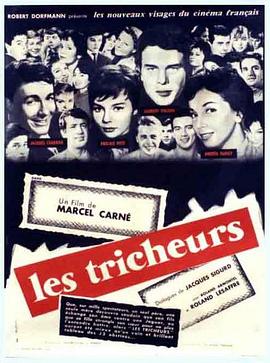
Middle class student Bob Letellier enters a new world when he meets Alain, a free-thinking rebel who, along with his group of young Parisians, has opted for a life of instant gratification instead of work and commitment. At a party, Bob meets a young woman, Mic, who appears to be just as carefree and cynical as Alain. Mic's only dream is to own a luxury car, and with Bob's help, she manages to find the money to but it. Mic's friend Clo discovers she is pregnant and, not knowing who the father is, she asks Bob to marry her. When they next meet at a party, Bob and Mic deny that they have any feelings for one another - a declaration that soon leads to tragedy... Marcel Carné is widely regarded as one of the standard bearers of French quality cinema of the 1930s and 1940s, responsible for such masterpieces as Quai des brumes (1938) and Les Enfants du Paradis (1945). How ironic then that, in 1958, towards the end of his film-making career, he should make a film which dared to portray the attitudes and behaviour of the 1950s youth, in a way that effectively captures the mood and sentiment of the time. Les Tricheurs was a hugely controversial film, not least because of its blatant depiction of adolescent free-love, and was even banned in some regions of France. It also received some intensely unfavourable reviews, most notably from the young hotheads on the Cahiers du cinéma such as François Truffaut who cited this film as a prime example of the decline of French cinema into mediocrity. In spite of all this negative press, the film proved to be an astonishing commercial success, attracting five million cinema-goers, and was awarded the Grand Prix du Cinéma français in 1958. Whilst Les Tricheurs is not as flawless as Carné's earlier masterpieces, it is nonetheless a significant work, having the power to both shock and move its audience, whilst having great entertainment value. It evokes the mood of its time in a way that few French films of this period did, depicting young people as pleasure-seeking rebels, rejecting the austerity and discipline of the previous generation whilst pursuing a life without cares, responsibilities or love. Similarities with James Dean's films of the 1950s (most notably Rebel without a Cause) are apparent, although Carné's treatment of young people is far more abstract - in his film they merely symbolise a world that has lost its way, more or less victims of post-war prosperity. Although the young people in Les Tricheurs lack the authenticity to be totally credible, the film does make an important, and indeed quite disturbing point, about where the permissive society may be heading. Much of the pleasure of the film is in the performances from its four lead actors, Jacques Charrier, Pascale Petit, Laurent Terzieff and Andréa Parisy, although only Terzieff is really convincing in his role. Marcel Carné originally considered Alain Delon and Jean-Paul Belmondo for the parts of Bob and Alain respectively, before opting for Charrier and Terzieff. As a consolation, Carné offered Belmondo a smaller part in the film - alas too small for the actor to be noticed by the public. Belmondo's breakthrough had to wait until the following year when he starred in Jean-Luc Godard's revolutionary A bout de souffle, a film which offers a very different perspective of the youth generation.
When grief-stricken Mareta (Anapela Polataivao) takes a substitute teaching role at an elite prep school, she forms a choir to unite the privileged yet disconnected students. As they prepare for an all-school competition, her passion for life is reignited, transforming her students forever in this rousing crowd-pleaser.
imdb Plot summary Born in a small town in the countryside surrounding Pistoia, Adriana is an attractive young girl who counts on using her looks to go places in the entertainment business in Rome. Moving to the capital, she works first of all in a hairdressing salon, then in a small cinema where she manages to get a job working in fancy dress. Meantime, she socializes with young men of the upper middle classes, who take her to parties and out on the town with the sole aim of taking advantage of her. Adriana knows their game, but plays along. In the meantime, she meets an agent called Cianfanna, a modest money-grubber who introduces her to a journalist friend of his so he can write an article on her. Having thus launched her career in advertising, Adriana decides to go home to visit her parents. Once home, however, she is distraught to learn of the death of her sister. Returning to Rome, she takes acting lessons, but during one lesson she suddenly faints she is pregnant, with no idea of who the father of her child is. The days go by and Adriana tries to forget about her pregnancy, while sleeping with an increasingly long list of lovers. And yet, despite the fact these encounters are often less than enjoyable, at one point she actually falls in love his name is Antonio and he's a decent young man from a respectable family, but still in love with a former girlfriend he is unable to forget…
16岁的男孩Craig克雷格(凯尔·吉克瑞斯特 饰)经常会想象自己的死亡,在尝试多种药物皆没有效果后,自己来到精神病院接受治疗。在那里,他和一个自杀了几次却没能死掉的神神叨叨的Bobby鲍比(扎克·加利费安纳基斯 饰)成了朋友,还认识了一个特别的女孩Noelle,当然还有许许多多的“非正常人”。他们几个在医院的生活中,渐渐寻回了生命的意义,尤其是鲍勃·迪伦的歌词“He Not Busy Being Born Is Busy Dying”给了他们巨大的力量,让他们重新拥有勇气去面对生活的压力。最后,出院的克雷格是否能让他原本阴霾密布的生活重见阳光,他又将通过怎样的方式找回轻松充实的生活? 本片改编自Ned Vizzini的同名小说,在布鲁克林的一所大学预科学校和一所医院取景拍摄。