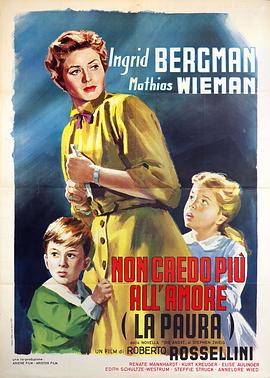
Whenever I see La Paura I think of it as a companion piece to Eyes Wide Shut, or maybe it is the other way around. Adultery makes both films tick but in different ways. I think Phillip French was right on the money when he pointed out a Wizard of Oz thing in Kubrick's last work. Like Dorothy, Tom and Nicole go through fantasies and nightmares and at the end Dorothy's reassuring childish motto there's no place like home is ironically updated to the adult circumstantial adage there's no sex like marital sex. Kubrick's take is intellectual, he never leaves the world of ideas to touch the ground. He taunts the audience first with an erotic movie and then with a thriller and refuses to deliver either of them. He was married to his third wife for 40 years, until he died. Rossellini was still married to Ingrid Bergman when he directed La Paura; they had been adulterous lovers and their infidelity widely criticized La Paura is a tale, a noirish one. The noir intrigue is solved and the tale has a happy ending. The city is noir; the country is tale, the territory where childhood is possible. The transition is operated in the most regular way by car, a long-held shot taken from the front of the car as it rides into the road, as if we were entering a different dimension. Irene (Bergman) starts the movie we just see a dark city landscape but her voice-over narration tells us of her angst and informs us that the story is a flashback, hers. Bergman's been cheating on her husband. At first guilt is just psychological torture but soon expands into economic blackmail and then grows into something else. From beginning to end the movie focuses on what Bergman feels, every other character is there to make her feel something. Only when the director gives away the plot before the main character can find out does he want us to feel something Bergman still can't. When she finds out, we have already experienced the warped mechanics of the situation and we may focus once again on the emotional impact it has on Bergman's Irene. In La Paura treasons are not imagined but real, nightmares are deliberate and the couple's venom suppurates in bitter ways. Needless to say, Ingrid has another of her rough rides in the movies but Rossellini doesn't dare put her away as he did in Europa 51, nor does he abandon her to the inscrutable impassivity of nature (Stromboli). His gift is less transcendent and fragile than the conclusion of Viaggio in Italia. He just gives his wife as much of a fairy tale ending as a real woman can have, a human landscape where she can finally feel at home. Back to the country, a half lit interior scene where shadows suggest the comfort of sleep. After all, it's the fairy godmother who speaks the last words in the movie.
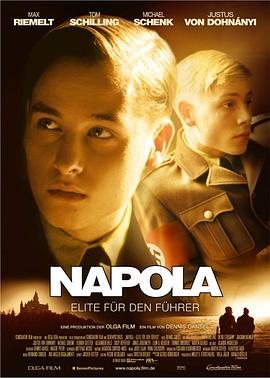
1942年的德国,17岁的少年Friedrich(马克思·雷迈特 Max Riemelt 饰)努力训练自己,梦想有朝一日能够加入纳粹的训练营。在通过重重考试之后,他获得了机会,然而他的父亲却极力反对,于是他伪造父亲在文书上签名,成功成为了训练营的一名成员,开始了每天艰苦的训练。在其中,他认识了Albrecht(汤姆·希林 Tom Schilling 饰),一个德国军官的儿子,两人建立了深厚的友情。然而Albrecht却不热衷于纳粹,反而更喜欢文学和写作。Albrecht的父亲却希望儿子跟他一样,以后成为一名纳粹军官,两人矛盾不断。在训练营里,Friedrich和Albrecht发现了许多丑恶的现象,Friedrich的信仰开始有所动摇。而在一次水中训练中,Albrecht却再也没有从水中出来...... 本片获2003德国电影奖最佳原创剧本奖。
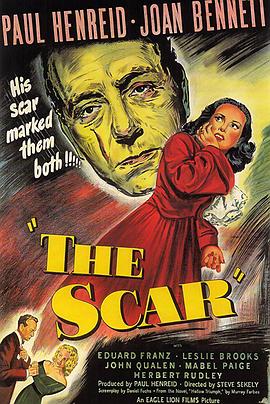
John Muller, medical school dropout and brilliant crook, plans a holdup which goes a little bit wrong, and finds vindictive gambler Rocky Stansyck after him. At the end of his tether, he stumbles onto a lucky chance to assume an impenetrable new identity as psychiatrist Victor Bartok. But irony piles on as Muller finds it's out of the frying pan, into the fire.
This documentary provides an intriguing and humorous glimpse into our species' impact on the Earth by exploring how one of the most simple and obvious solutions to aid the environment may lie in what we often look down upon as waste. It just may be that the hero we all need, but don't deserve, shall be apparent when 'Sh*t Saves the World.'